
Living in Tampa Bay comes with plenty of perks: beautiful beaches, year-round sunshine, and a lifestyle that blends outdoor living with vibrant communities. But the same environment that makes this area so appealing also creates severe hidden challenges for our floors. Constant humidity, frequent tropical rainfall, and intense summer sun take a serious toll on concrete—whether in a residential garage, patio, pool deck, or commercial facility.
As the owner of Floor Coating Specialist, I’ve spent over a decade helping homeowners and businesses across Southwest and Central Florida protect and upgrade their concrete surfaces. Through hundreds of installations, I’ve tested which materials hold up best against local conditions. One solution consistently outperforms the rest in durability, performance, and long-term appearance: polyaspartic floor coatings.
Florida’s Climate and the Challenge for Concrete Floors
Concrete is tough, but it isn’t invincible. In Tampa Bay’s high-humidity environment, moisture seeps into untreated concrete, leading to cracking, pitting, and mildew growth. Combine that with relentless UV exposure, and bare or improperly sealed concrete breaks down much faster than property owners expect.
Traditional epoxy flooring systems, while widely used, present major failure points in Florida:
- Sunlight Discoloration: Epoxy resin is inherently UV-sensitive, causing it to yellow and chalk under direct Florida sunlight.
- Extended Cure Times: Epoxy requires days to cure properly, leaving uncured floors vulnerable to airborne moisture and sudden rain showers during installation.
- Moisture Trapping: Rigid epoxy coats fail to handle ground-level moisture pressure, leading to premature peeling and blistering.
For residential projects—like garage floors, patios, and pool decks—or commercial spaces—such as retail stores, restaurants, and showrooms—these limitations mean traditional epoxy often fails long before its expected lifespan.
Technical Deep Dive: Moisture Vapor Transmission (MVT) & Florida Water Tables
To understand why traditional coatings fail in Tampa Bay, you have to look below the surface. Tampa Bay’s shallow water tables and high soil humidity exert constant hydrostatic pressure beneath concrete garage and patio slabs. Moisture vapor migrates upward through the porous concrete in a process called Moisture Vapor Transmission (MVT).
- Epoxy’s Vulnerability: Standard epoxy forms a rigid, non-breathable film over the concrete surface. As moisture vapor pushes upward from the wet Florida soil, trapped hydrostatic pressure builds beneath the coating. This forces the film to blister, bubble, and eventually flake off in sheets.
- Polyaspartic’s Advantage: Polyaspartic coatings have a much lower application viscosity, allowing the material to penetrate deep into the concrete’s open capillary pores before cross-linking. When paired with a dedicated moisture-mitigation basecoat, polyaspartic systems withstand Moisture Vapor Emission Rates (MVER) up to 12 lbs/1,000 sq. ft./24 hours—blocking hydrostatic lifting before it can start.
- 100% Aliphatic UV Stability: Florida garages with open doors receive hours of direct UV exposure every day. Aromatic epoxy coatings turn amber and chalk within months. Aliphatic polyaspartic chemistry remains crystal clear, non-yellowing, and UV-stable for decades.
Why Polyaspartic Outperforms Epoxy in Tampa Bay
Polyaspartic coatings combine extreme strength, flexibility, and rapid curing, making them ideal for homes and businesses throughout the region.
- Complete Moisture Defense: High relative humidity and heavy rainfall won’t break polyaspartic’s mechanical bond to properly diamond-ground concrete, establishing a permanent barrier against water intrusion.
- Superior UV Resistance: Aliphatic polyaspartic maintains its original color and high-gloss clarity under direct sun, making it the premier choice for outdoor patios, lanais, pool decks, and open garage bays.
- Single-Day Installation: Downtime is a massive issue for homeowners and businesses alike. While epoxy takes up to a week to cure, polyaspartic cures in hours. Most residential garages are fully completed in just one day.
- Resilience Against Heavy Wear & Hot Tires: Polyaspartic systems are engineered to handle high foot traffic, vehicle loads, oil spills, and harsh chemicals in residential garages, heavy commercial warehouses, showrooms, and healthcare facilities.
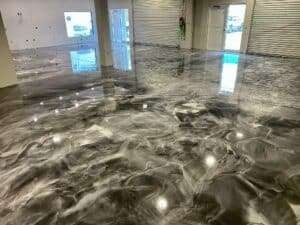
- Custom Aesthetics: Polyaspartic offers complete design flexibility. From full-chip decorative vinyl flake systems to metallic finishes and custom color blends, you can match your home’s aesthetic or project a clean, professional corporate image.
Why I Recommend Polyaspartic to My Clients
Over the years, I’ve spoken with countless homeowners who were frustrated by chipped DIY garage paint, peeled contractor epoxy, or faded patio slabs. Once we mechanical-prep their concrete with industrial diamond grinders and install a full polyaspartic system, the reaction is always the same: “I wish we had done this years ago.”
Installing a floor coating isn’t just about putting down a cosmetic finish—it’s about delivering an engineered, moisture-resistant barrier that thrives in Florida’s climate. Polyaspartic gives my clients peace of mind, knowing they’ve made a long-term investment backed by true trade performance.
Flooring Built for Florida Living
Florida living is about enjoying the outdoors, building inviting homes, and running businesses that look crisp and professional. Your floors should support that lifestyle, not require continuous maintenance and repainting.
At Floor Coating Specialist, we handle every stage of the process—from initial moisture testing and dust-free diamond grinding prep to custom color selection and precision application.
Frequently Asked Questions (Tampa Bay Climate & Installation)
Can polyaspartic coatings be installed during Florida’s rainy summer season?
Yes. Unlike epoxy, which requires low ambient humidity and up to 72 hours of dry weather to cure properly, polyaspartic reacts with ambient moisture in the air to accelerate its curing cycle. A professional crew can grind, coat, broadcast, and seal a garage floor in a single day—even during humid summer conditions.
How does hot-tire pickup happen, and why does polyaspartic prevent it?
When vehicle tires run on hot Florida highways, friction heats the rubber to 130°F–140°F. When parked on a standard epoxy floor, the cooling tires contract and grip the rigid coating, pulling it straight off the concrete. Polyaspartic features a much higher heat deflection rating and superior tensile elongation, completely preventing hot-tire delamination.
How long before I can walk and park on my new floor?
With our rapid-cure polyaspartic system, you can walk on the surface within 4 to 6 hours. Heavy items, patio furniture, and personal vehicles can return to the space in 24 hours (compared to the 5 to 7 days required for standard epoxy).
Upgrade Your Tampa Bay Concrete Floors
Ready for a high-performance floor coating that resists heat, UV rays, and moisture vapor? Contact Floor Coating Specialist today to schedule your consultation and free project estimate.